Ignoring private innovation is no longer an option for tech investors
As private technology companies stay private longer and grow larger than any time in history, having exposure to these companies is rapidly transitioning from a nice-to-have to a necessity.

- 01Six tech sectors will define the next decade: AI, Quantum, Cybersecurity, Space, Defense, and Robotics.
- 02Public-market exposure suffers from a "dilution effect". Only ~36% of major AI-name market cap is actually attributable to AI.
- 03Private companies hold meaningful and rapidly growing share of pure-play value across all six sectors. Public-only allocations leave significant upside on the table.
As private technology companies stay private longer and grow larger than any time in history, having exposure to these companies is rapidly transitioning from a nice-to-have to a necessity.
6 major technological trends will shape the world over the next decade: AI, Quantum Computing, Cybersecurity, Space Tech, Defense Tech, and Robotics. I researched each of these sectors with the initial goal of identifying the major publicly traded and privately held firms driving innovation within each.
The overall objective was to determine whether public market investments alone could capture the full economic upside of these major tech trends over the next 5+ years, or if private market exposure was critical for complete returns.
Tldr, private investment is essential.
Tailwinds
Before we dive into each sector at a more granular level, it's worth exploring what's happening in the world today, what may happen over the next 5 - 10 years, and why these 6 sectors represent the most likely vectors of outsized growth.
Everything begins with AI. From the moment a team of 8 Google researchers published the seminal paper on transformer architecture in 2017, AI-research labs around the world began immediately implementing this architecture in their proprietary (and open source) models. After a relatively quiet 5-year period of development (at least to AI-outsiders), the dam finally broke in late 2022 as the release of ChatGPT 3.5 quickly became a worldwide phenomenon. Transformer architecture now underpins the world's most advanced large language models like ChatGPT, Claude, Gemini, and others. However, the underlying architecture is much less important than what these models offer – 24/7 access to intelligence. As any user of LLMs over the past few years has come to understand, the models aren't perfect, but they also "know" more than any human you've ever met and are seemingly improving with each successive new model release. The mistakes are baffling, like failing to be able to consistently do elementary school math, but also writing 2,000 line working python scripts in one-shot. Whether or not AGI is achieved in the next decade, nearly a billion people globally are using an LLM to help complete tasks every week, which is pretty wild considering there were likely fewer than a hundred users in 2022.
It's safe to say AI is here to stay.
In the early 1980s, quantum computers were initially theorized by Richard Feynman and a few other researchers, now 45 years later, still not a single person has a quantum laptop or a quantum smartphone in their pocket. But, recent breakthroughs are suggestive of a possible light at the end of the proverbial tunnel. Commercialization of quantum computing remains scarce, and most development efforts seem to be relegated to billion-dollar research labs at Microsoft, Google, IBM, and others. However, in late 2024, Google unveiled its "Willow" quantum chip that solved a decades-old problem: how to make quantum computers less error-prone as they grow larger.
For 30 years, adding more quantum bits meant more errors—making scaling essentially self-defeating. But when Google expanded their quantum array from a 3x3 grid to 5x5 to 7x7, the error rate got cut in half each time. Quantum researchers are likening this breakthrough to the Wright brothers' first flight in that it's taken theory and proven the mechanical feasibility. While it may be 15-20 years before any form of mass commercialization, we've finally proven it's possible.
These two technological forces, AI's explosive growth and quantum computing's looming arrival, are creating a perfect storm for cybersecurity.
AI is enabling humans to create more data per second than at any other time in history. In 2025, we're expected to generate 180 zettabytes of computer code, images, audio, written text, video, and other data. All of this data must be securely stored, securely transmitted, and securely accessed for indefinite periods of time. The amount of data is profound, but the exact data that's being ingested and created often involves company IP, personal identifying information, and other highly sensitive information that would make a data leak for a major AI firm absolutely catastrophic.
All of this data must be encrypted, but what's frightening is that quantum computers will be able to instantaneously crack the vast majority of today's most commonly used encryption methods. Cybersecurity firms are now in a race against time to develop quantum-resistant encryption while dealing with increasingly novel AI-powered attacks. It's a challenging time to be building in the cybersecurity space, but the opportunity for winners is absolutely massive.
The fight for global intelligence supremacy is well underway with AI capabilities increasingly viewed as national security assets by both the U.S. and China. In my view, we are entering a period that will be looked back on in history similar to the Manhattan Project in the 1940s. The first nation-state to achieve AGI will have an unprecedented advantage—though unlike nuclear weapons, that monopoly might last months, not years. Thus, the AI-race has begun to bleed into the physical domain as nations around the world ready themselves for the potential of new hot wars. The enormous amount of public and private financing into Defense Tech and Space Tech firms supports this thesis.
Control of low-Earth orbit means you have control of global defense capabilities. Space-based missile defense, surveillance, and communications are redefining warfare. Ultimately, Defense and Space are rapidly becoming one sector; orbital supremacy is military supremacy.
There are, of course, the more optimistic long-term opportunities in space, e.g., lunar resource extraction, Martian settlements, and asteroid mining. These aren't fantasies; they're just engineering problems with 10-30 year timelines. But in the near term, space and defense are effectively one sector, and that's where the smart money is headed.
Finally, robotics. The physical manifestation of the intelligence revolution. With AI foundation models now being trained on robotic movements (e.g., teaching machines to understand and interact with the physical world the way LLMs understand text), we are likely to see dramatic strides made in the next few years. Firms like Boston Dynamics have been grinding away for three decades with little consumer-facing impact beyond the occasional viral video of a dog robot doing backflips (an undoubtedly incredible engineering feat, but why do I care?), whereas Figure AI recently released a video of a humanoid robot loading a laundry machine and folding the clothes afterwards (also an amazing engineering feat and I want one immediately).
With that backdrop, it's time to dive into the 6 sectors discussed above and the various firms driving innovation within each.
AI
One concept that will appear in all explored sectors is the "dilution effect". In the context of this article, I am referring to the unfortunate case of investing into a large, generally multi-trillion dollar tech company to obtain "AI exposure" and then finding out that AI-derived revenue streams only account for 15% - 20% of their topline. So, you get your exposure, but the future realized upside is going to be meaningfully diluted by other business lines.
When comparing publicly traded AI-companies vs. their privately held peers, I needed to first understand what percentage of their current market cap could be reliably attributed to AI-derived revenue streams. As you can see in the graphic at the bottom of this section, while the total current market cap of major, AI-oriented firms is $22.4T, the pure AI value is closer to $8.3T, a bit over 36%. Thus, if you were to buy the below basket of AI names in the public market, only $0.36 of each dollar invested would be going towards pure AI.
To derive the cumulative $8.3T figure, I performed a bottom-up analysis where I analyzed each public issuer to understand what percentage of total topline revenue could be reliably attributed to AI-critical services or products, then applied market-derived multiples on all revenue streams, and then backed into the approximate value of their current market cap that could be reliably attributed to AI.
To understand the dilution effect, consider the following two examples. NVIDIA, the purest AI play in public markets, has 88% of its value coming from AI datacenter revenue (via GPU purchases), but you're still buying 12% gaming GPUs and visualization products. Microsoft is worse: despite all the Copilot hype, AI generates only ~$18 billion of their $260+ billion in topline revenue. Even with premium multiples, that's 15% AI attribution at best. So when you buy Microsoft for AI exposure, 85% of your money goes toward Windows licenses and Xbox games.
For private issuers, I used a combination of the most recent fundraising round valuation, mutual fund marks, private secondary transaction marks, and recent news if materially impactful to valuation. I realize that valuations can be volatile in the private market, but I am confident that the valuations listed below are defensible as of the end of August. The total value of the 22 selected private issuers is $810B. These private leaders are capturing the AI revolution's most explosive segments: OpenAI's $13B+ ARR growing at 100% annually, Anthropic's revenue increasing 150x since early 2024, and emerging players like Perplexity handling 400M+ monthly queries. These are growth rates impossible at public company scale.
Today, private issuers account for approximately 9% of total AI Value in the market, a material segment of value.
The next critical piece of the analysis was understanding the projected 5-year growth rate and projected value appreciation of both the public and private segments. With any projection, there will be large error bands, and with an emergent technology like AI, those bands are probably wider than average. The research effort here was again a bottom-up effort to understand the current growth dynamics of the AI-portion of the public issuers' market cap and the pure growth of the private issuers' valuation (since all issuers are pure play AI). The final projections suggest the cumulative AI-portion of market cap among public issuers will grow at ~19.2% annually over the next 5 years, and the cumulative private issuer value growth will be ~32.4% annually.
This differential makes sense considering most private issuers are smaller in size, more volatile in possible returns, with unbelievable upside cases balanced by the reality that 30-40% will fail entirely. Nonetheless, the AI firms that are currently privately held offer a compelling potential allocation, if for nothing else to avoid missing out on nearly 10% of the current addressable market.
Per my analysis, the 2030 market split of pure AI value is projected to be 14% (current private issuers) and 86% (current public issuers). The total value of private issuers is expected to 4x over the next five years from $810B to $3.3T, and the total AI-value of public issuers is expected to 2.5x. However, and this is the critical point, investors cannot isolate the AI portion of public companies. They must buy the entire company, accepting all its legacy businesses, which will inevitably drag realized returns far below the 2.5x potential of the AI segment alone.
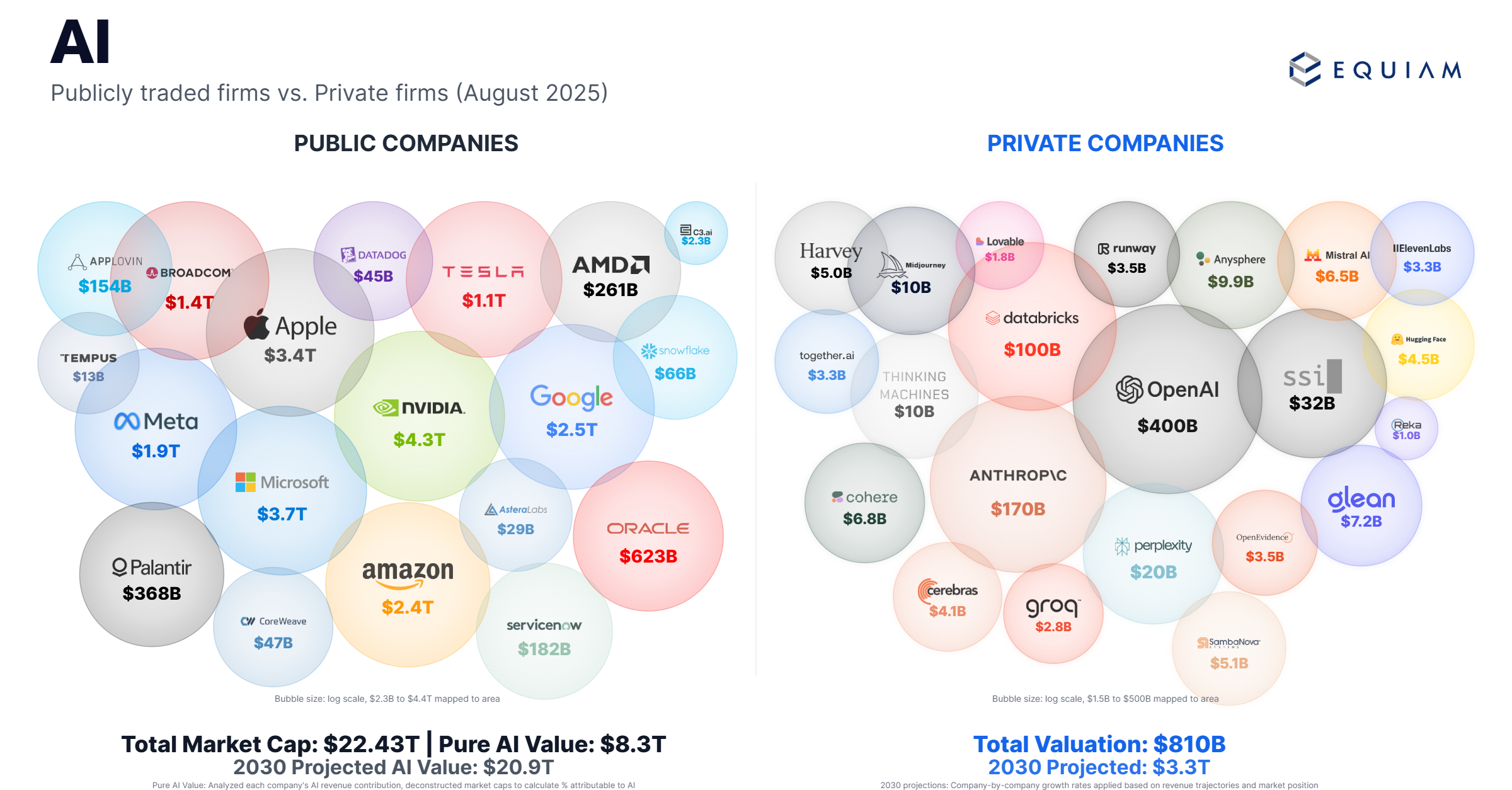
Public issuers: NVIDIA, Microsoft, Apple, Google, Amazon, Meta, Broadcom, Tesla, Oracle, Palantir, AMD, ServiceNow, AppLovin, Snowflake, CoreWeave, Datadog, Astera Labs, Tempus, C3.ai
Private issuers: OpenAI, Anthropic, Databricks, SSI, Perplexity, Thinking Machines, Midjourney, Anysphere, Glean, Mistral, Cohere, SambaNova, Harvey, Hugging Face, Cerebras, OpenEvidence, Together AI, ElevenLabs, Groq, Lovable, Runway, Reka AI
Quantum
In comparison to AI, we see a much more even value distribution today between the pure Quantum value in public issuers vs. the Quantum value calculated for private issuers. Today, the Pure Quantum value among public issuers is $39.3B, and $17.0B among private issuers, good for a 70% / 30% split.
Solely allocating to publicly traded firms active in Quantum, while forgoing privates, would leave a significant underallocation to the sector at present. Not to mention the dilution effect. Unlike AI where a meaningful (but still minority) portion of market value is attributable to the technology, only around 0.35% of the $11T of market value among public issuers in the graphic below can be attributed purely to Quantum. This is a stark reminder of where we are in the commercialization journey of quantum computing.
The 5-year forward projections show an aggressive narrowing between the Quantum value slice among current public issuers and the private Quantum value. The final projections suggest the cumulative Quantum-portion of market cap among public issuers will grow at ~37.8% annually over the next 5 years, and the cumulative private issuer value growth will grow at ~51.4% annually. Similar to AI, these growth expectations should be taken as a potential outcome, but one within a massive band of possible outcomes.
The projected value split would be 60% public quantum-value / 40% private quantum value.
If the above case holds, the cumulative private Quantum-value will 7.7x in value from $17.0B to $131B, while the pure Quantum-value of publicly traded issuers will 5.0x. Again, as mentioned above, there is no reliable way to only invest into the quantum-segment of publicly traded issuers, so actual realizable returns will likely be muted in comparison.
Note: Both the 7.7x private and 5.0x public quantum projections assume the industry finally cracks fault tolerance by 2027-2028—a milestone that's eluded researchers for decades. These multiples price in PsiQuantum's photonic approach working at million-qubit scale, neutral atom platforms like QuEra achieving commercial viability, and public players like IonQ jumping from $95M to $1B revenue. In context, even this aggressive growth merely takes private quantum from 2% to 4% of private AI market value, while public quantum attribution crawls from 0.35% to perhaps 0.75% of tech giant valuations, graduating from rounding error to merely small in both cases.
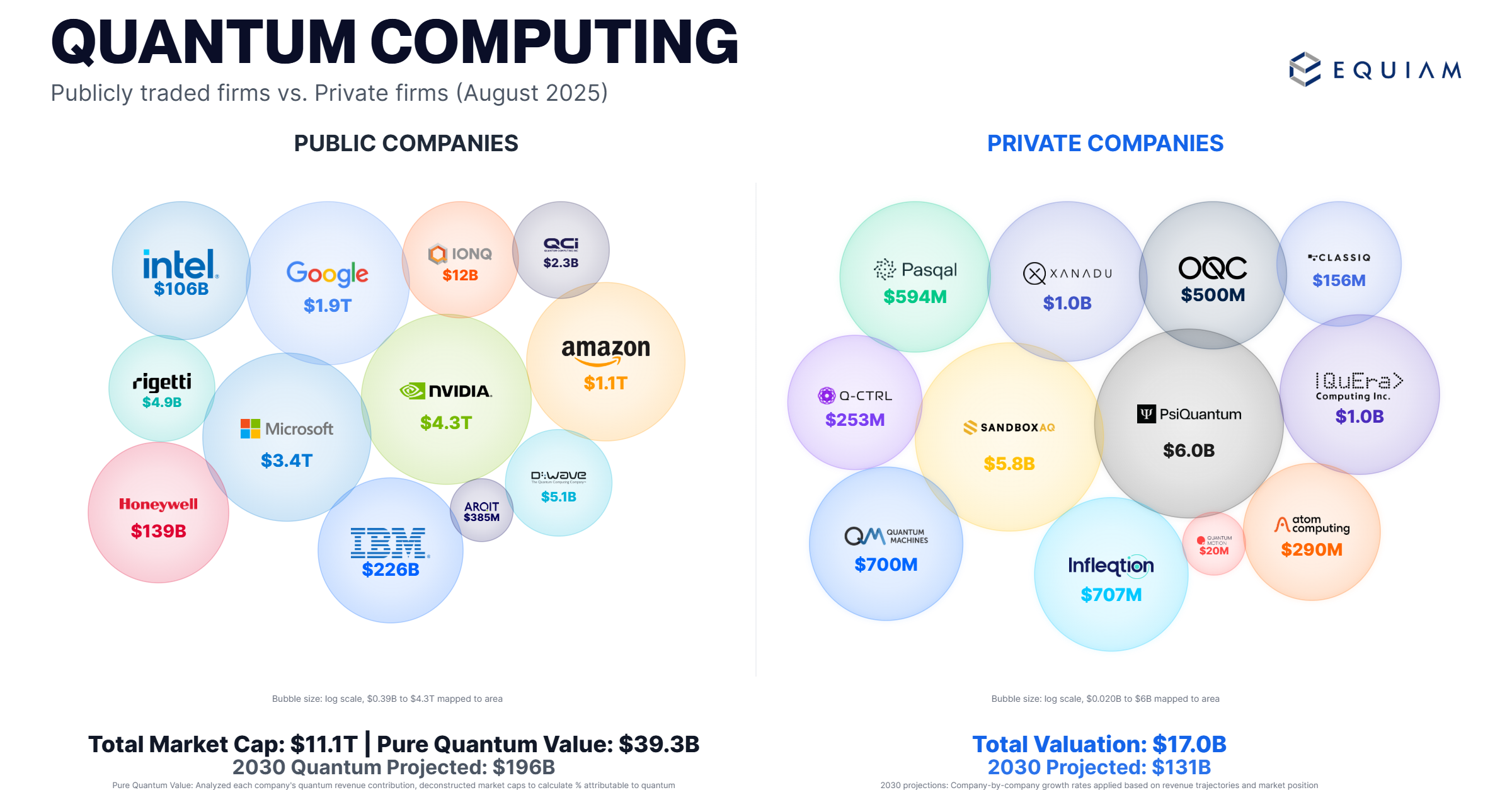
Public issuers: Nvidia, Microsoft, Google, Amazon, IBM, Honeywell, Intel, IonQ, D-Wave, Rigetti, Quantum Computing Inc, Arqit Quantum
Private issuers: PsiQuantum, Atom Computing, Xanadu, QuEra, Infleqtion, Oxford Quantum Circuits, Quantum Machines, SandboxAQ, Pasqal, Quantum Motion, Q-CTRL, Classiq
Cybersecurity
The Cybersecurity sector is relatively skewed today towards large pure-play public incumbents like Crowdstrike, Palo Alto Networks, and Cloudflare alongside more fragmented players like Broadcom (owners of Symantec, a low-growth legacy business) and Cisco (Splunk acquisition + organic Cisco security solutions). The current pure play cybersecurity value among the selected public companies is $551B as of the end of August. The dilution effect is meaningful in the sector with only $0.26 of each dollar invested going to pure play cybersecurity in an equal-weight basket of the securities shown in the below chart.
Privately held cybersecurity firms represent current value of ~$62B, or ~10% of the current total pure cybersecurity market value among the selected public and private companies.
The 5-year forward projections reveal a meaningful growth differential: private cybersecurity companies are projected to grow at 34.3% annually versus 14.5% for the cybersecurity-attributable portions of public companies. As with prior sectors, these growth projections are meant to be understood as possible, not guaranteed outcomes; the band of outcomes particularly among the smaller, faster-growing private firms is likely to be especially wide.
The predicted 2.4x growth rate advantage stems from private companies' dominance in emerging categories like SASE (Netskope (imminent IPO), Cato Networks), enterprise browsers (Island), and AI-powered security (Abnormal Security). By 2030, private cybersecurity value is expected to reach $250B (a 4x increase) while public cyber-attributable value grows to $1.1T (2x increase), with private companies nearly doubling their market share from 10% to 18%.
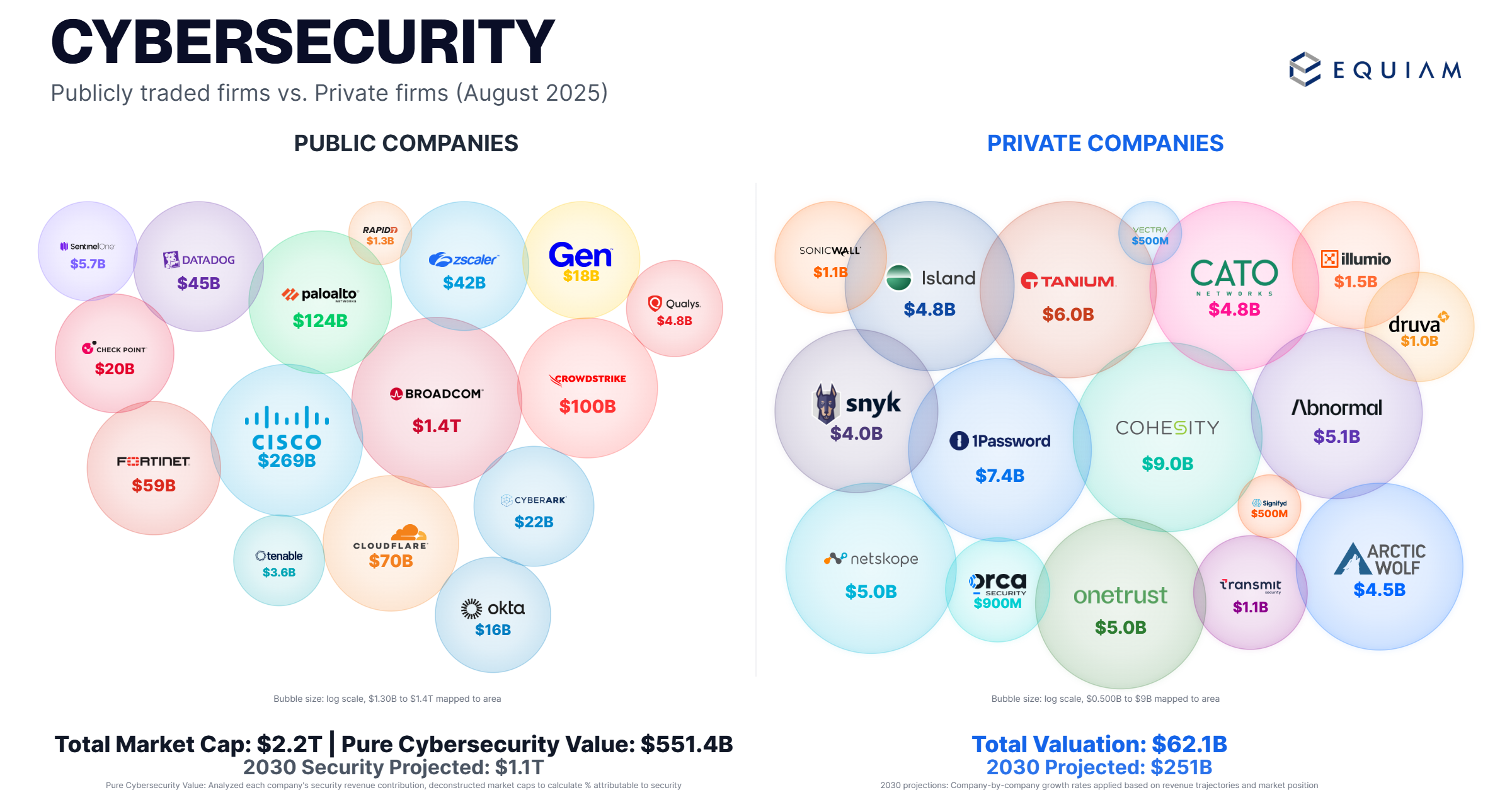
Public issuers: Broadcom, Cisco, Palo Alto Networks, CrowdStrike, Fortinet, Cloudflare, Datadog, Zscaler, CyberArk, Check Point, Gen Digital, Okta, SentinelOne, Qualys, Tenable, Rapid7
Private issuers: Tanium, Snyk, Netskope, 1Password, OneTrust, Abnormal Security, Cato Networks, Arctic Wolf, Cohesity, Illumio, Transmit Security, SonicWall, Druva, Orca Security, Signifyd, Island, Vectra AI
Defense
The Defense Tech sector presents the starkest David vs. Goliath narrative in our analysis. Traditional defense primes like Lockheed Martin, RTX, and Northrop Grumman dominate with $989B in defense-attributable value, while private defense tech companies represent just $62B, roughly 6% of the total defense market cap as of today.
The dilution effect is less severe here than other sectors, with 62% of public company value attributable to defense ($0.62 of each dollar invested in the basket shown below goes toward defense). Yet these public giants remain locked into cost-plus contracts and multi-decade development cycles, while companies like Anduril and Shield AI build AI-powered autonomous systems on venture timelines.
The 5-year forward projections show private defense tech companies growing at ~40% annually versus ~13% for defense-attributable portions of public companies. These projections assume successful navigation of DoD procurement cycles and the Pentagon's historic resistance to Silicon Valley adoption.
This 3x growth rate advantage reflects private companies creating entirely new categories like Anduril's autonomous weapons factory targeting 10,000+ units annually, Shield AI's Hivemind AI pilot for F-16s, and Saronic's naval drone swarms backed by $392M in Navy contracts. By 2030, private defense tech value could reach $330B (5.3x increase) while public defense-attributable value grows to $1.8T (1.8x increase), with private companies capturing 15% of total defense value, up from today's 6%. Unlike other sectors where technical risk dominates, defense tech faces the additional challenge of customer concentration risk: essentially one buyer (DoD) with procurement cycles measured in decades, not quarters.
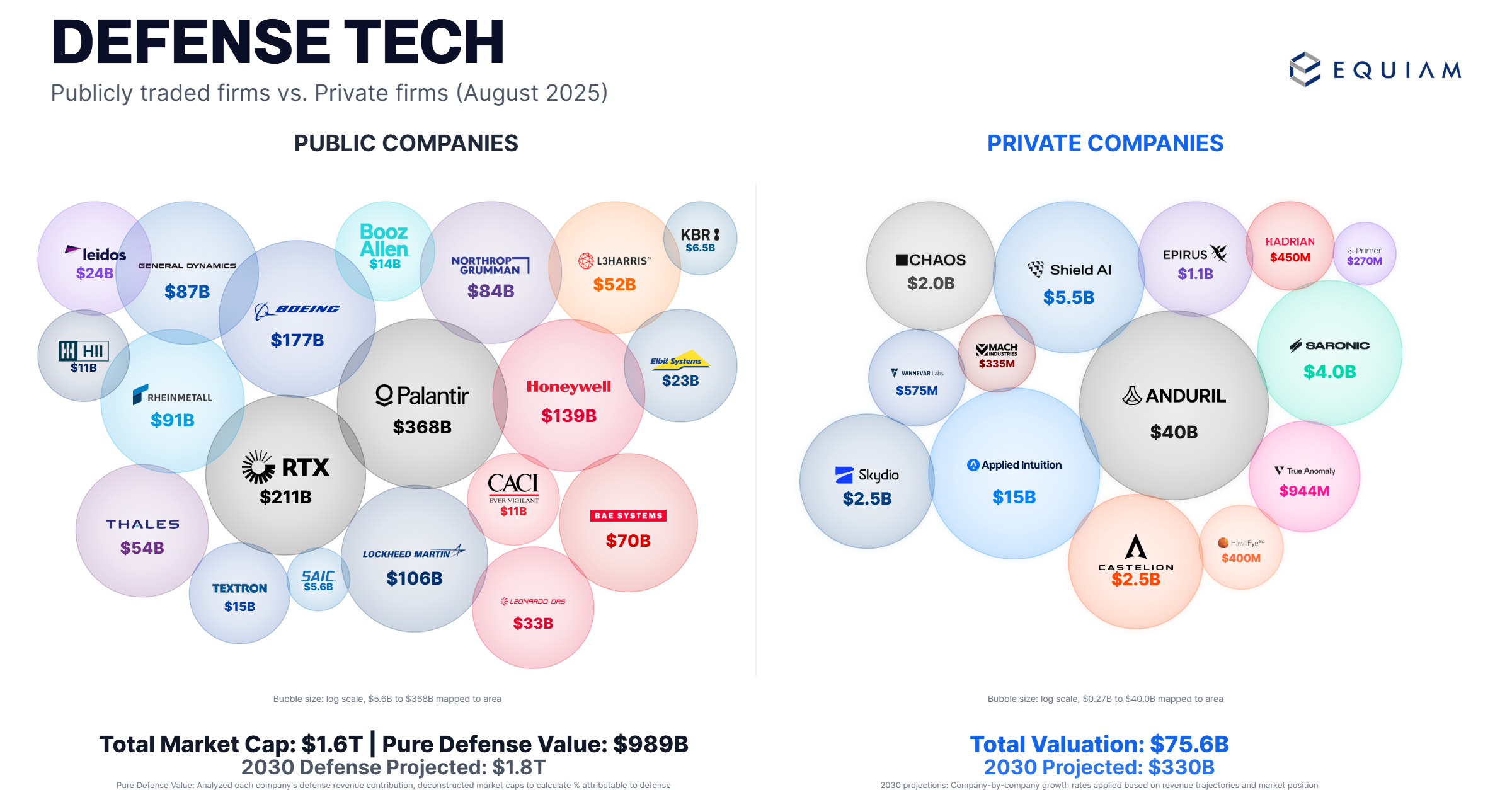
Public issuers: Palantir, RTX, Boeing, Honeywell, Lockheed Martin, General Dynamics, Northrop Grumman, BAE Systems, Thales, L3Harris, Leonardo, Rheinmetall, Leidos, Booz Allen, Textron, Elbit Systems, CACI, Huntington Ingalls, SAIC, KBR
Private issuers: Anduril, Applied Intuition, Shield AI, Saronic, Castelion, Skydio, Epirus, True Anomaly, Vannevar Labs, Mach Industries, Hadrian, HawkEye360, CHAOS Industries, Primer
Space
The Space Tech sector inverts every pattern we've established. Private companies dominate with $492B in value versus just $193B in space-attributable value for public companies, making this the only sector where private players represent 72% of total market value.
The dilution effect in public markets is severe, with only 19% of public company value attributable to space ($0.19 of each dollar invested in the basket below goes toward space). Boeing's space division represents 12% of company value, Northrop Grumman leads at 33%, while most aerospace giants hover around 8-18% space attribution. Pure-play public options exist (Rocket Lab at $23B, AST SpaceMobile at $17B) but remain relatively small.
The 5-year forward projections show private space companies growing at ~40% annually versus ~21% for space-attributable portions of public companies. These projections assume Starship achieves operational status, Blue Origin's New Glenn scales successfully, and commercial space stations deploy before ISS retirement in 2030.
This 4x growth rate advantage reflects SpaceX's extraordinary position: at $400B, it exceeds the entire space-attributable value of all public companies combined. With Starlink approaching 8 million subscribers and revenue projected to reach $300B by 2035, SpaceX has created a vertically integrated space economy. By 2030, private space value could reach $2.6T (5.3x increase) while public space-attributable value grows to $495B (2.6x increase). The concentration risk is unprecedented: SpaceX alone represents 58% of the entire space sector's value today and could account for 73% by 2030, making not just private space investing but the entire space economy dependent on one company's execution.
Note: While the SpaceX concentration creates obvious risk, several factors suggest this dominance may persist. SpaceX has become critical infrastructure for U.S. national security (launching 80%+ of DoD payloads), NASA depends entirely on them for ISS crew transport, and Starlink provides battlefield communications for U.S. allies. The greater risk may be execution challenges at this unprecedented scale rather than competitive or regulatory threats.
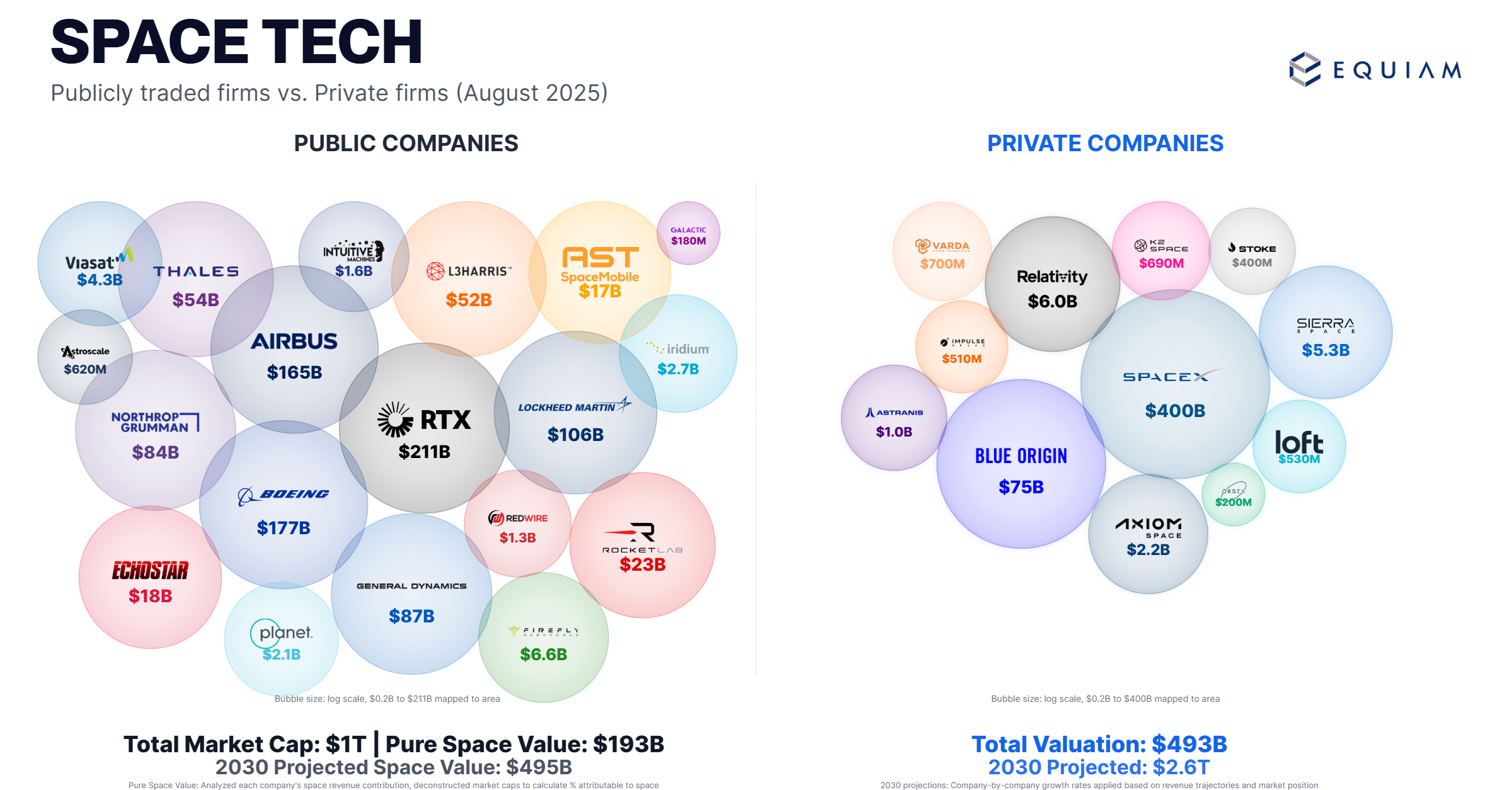
Public issuers: RTX, Boeing, Airbus, Lockheed Martin, General Dynamics, Northrop Grumman, Thales, L3Harris, Rocket Lab, AST SpaceMobile, EchoStar, Firefly, Viasat, Iridium, Planet Labs, Intuitive Machines, Redwire, Astroscale, Virgin Galactic
Private issuers: SpaceX, Blue Origin, Sierra Space, Relativity Space, Axiom Space, Astranis, Impulse Space, K2 Space, Loft Orbital, Varda Space, Stoke Space, Orbex
Robotics
The Robotics sector reveals another stark public/private divide. Public companies total $1.56T in market cap, but only $434B (28%) represents actual robotics value. Private robotics companies represent $57B, or roughly 12% of total robotics market value.
The dilution effect is significant, with only 28% of public company value attributable to robotics ($0.28 of each dollar invested in the basket below goes toward robotics). Tesla's inclusion inflates sector market cap while providing minimal robotics exposure - its $1.05T market cap contains only ~$26B (2.5%) of robotics value via the unproven Optimus program. Industrial leaders like Keyence (95% robotics) and Fanuc (100% robotics) offer better concentration, while Intuitive Surgical ($168B) dominates surgical robotics as a pure-play.
The 5-year forward projections show private robotics companies growing at ~47% annually versus ~18% for robotics-attributable portions of public companies. These projections assume Figure AI's $39.5B valuation (up from $2.6B last year) reflects actual commercial potential, humanoid robots achieve viable deployment, and AI foundation models from Skild AI and Physical Intelligence enable general-purpose robotics.
This 2.6x growth rate differential reflects private companies' ability to attack massive new markets while incumbents optimize mature ones. The labor shortage (2.1 million unfilled manufacturing jobs by 2030) creates unprecedented demand for automation. Figure AI targets 100,000 humanoid robots over four years, Zipline has proven drone delivery with one million completed deliveries, and Agility Robotics pilots robots-as-a-service at Amazon. Private robotics value could grow from $57B to $385B (6.8x) while public robotics-attributable value grows from $434B to $987B (2.3x), with private companies capturing 28% of total robotics value by 2030, up from 12% today.
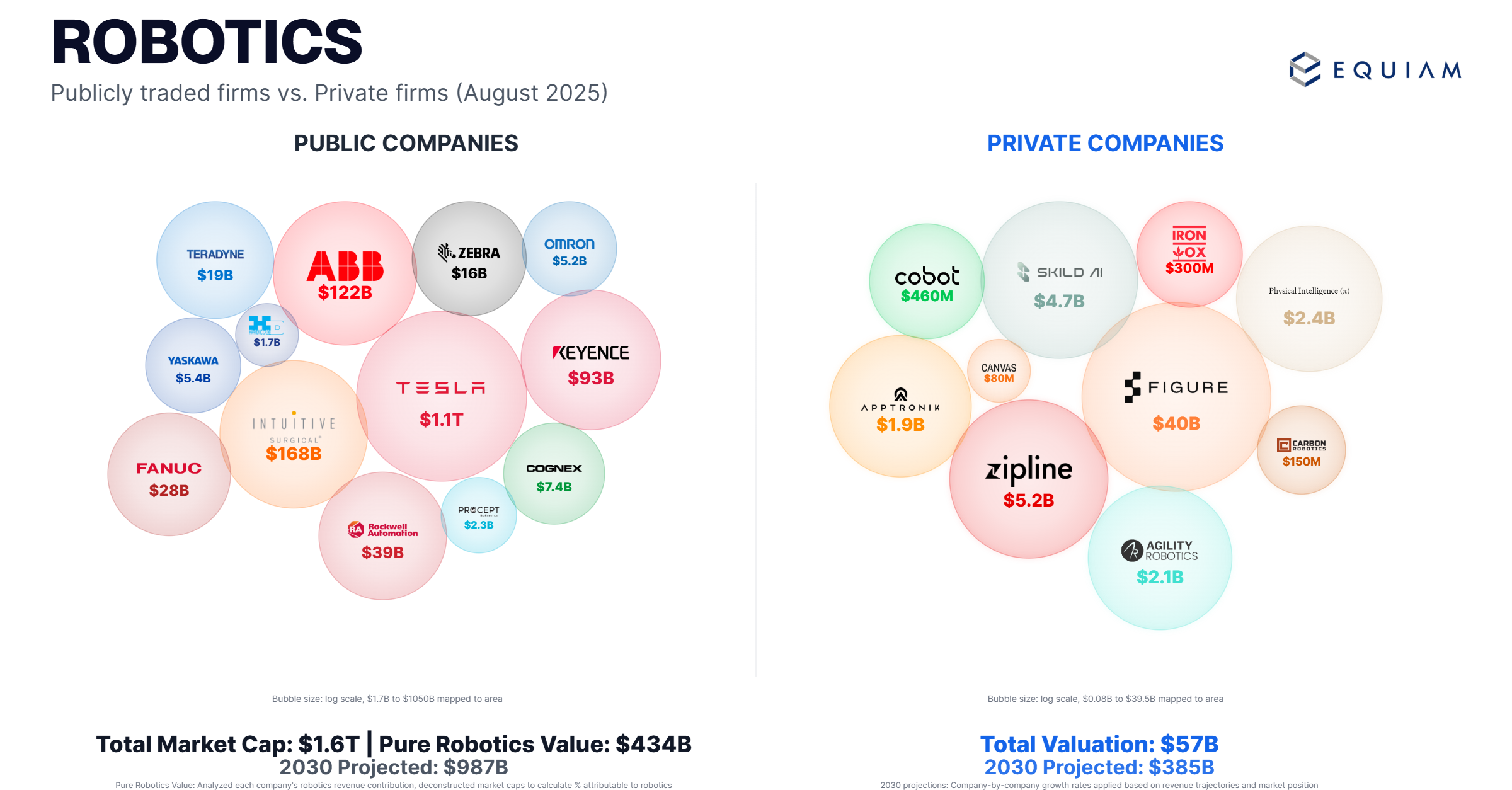
Public issuers: Tesla, Intuitive Surgical, ABB, Keyence, Rockwell Automation, Fanuc, Teradyne, Zebra Technologies, Cognex, Yaskawa, Omron, PROCEPT BioRobotics, Harmonic Drive
Private issuers: Zipline, Skild AI, Figure AI, Physical Intelligence, Apptronik, Agility Robotics, Carbon Robotics, Iron Ox, Collaborative Robotics, Canvas
Access pathways
If you've come to the conclusion that you'll need private company exposure to avoid being meaningfully underweight the most promising technological waves of the next decade, I'll detail a few methods for gaining exposure to some of the firms/sectors noted above.
The most well-known way to invest into privately held companies is through primary venture financing events (i.e., VC rounds). While these events are reported upon most frequently by Pitchbook and TechCrunch, actually gaining access to a primary round is extremely difficult for most institutional investors, let alone HNWIs. And gaining access to the very best companies is close to impossible.
I'll now detail four pathways that have emerged for accessing private markets, each with distinct trade-offs between liquidity, minimums, and quality of access.
1. Closed-end listed funds owning private securities. Accessible to: retail investors. These funds trade continuously during market hours subject to market liquidity. This highly-liquid nature is appealing to many investors as there are no long term lock-ups. The primary challenge is that closed-end listed funds notoriously trade at extreme discounts or premiums to the actual assessed Net Asset Value (NAV) of the fund. This can create significant opportunity or risk depending on which side of the pricing spectrum the fund sits.
2. Open-ended interval funds owning private securities. Accessible to: retail investors in most cases; however, some interval funds are strictly limited to Accredited Investors. These funds trade in a similar fashion to mutual funds with investors purchasing securities at the previous day's closing NAV. Interval funds allow for continuous inflow of investment dollars, but tend to only allow 5% of the fund value to be redeemed each quarter. This liquidity provision is generally viewed as a positive for many investors, but this also forces the fund manager to maintain ~20% of fund assets in low-risk, highly liquid securities (usually a mix of U.S. treasuries and cash), creating a 3-5% annual performance drag versus fully invested strategies. Also, during periods of extreme market stress, all investors tend to rush for the door at the same time with many only able to liquidate a tiny portion of their holdings. At 5% quarterly redemption limits, it would take an investor 20 quarters (5 years) to fully exit their investment if all other investors in the interval fund were also seeking to exit.
3. Private securities purchases via secondary brokerage platforms. Accessible to: Accredited investors in most cases, occasionally limited to qualified purchasers. Accredited investors can use private secondary brokerage platforms to purchase single positions in some of the larger, more liquid late-stage private firms. The main challenge here is that these platforms typically require $100K - $250K minimums to participate in discrete transactions. Some platforms have begun reducing the minimum investment threshold, but many of the more accessible deals are often the least desired, hence why they are aggregating demand among smaller investors.
4. Specialized GP/LP funds providing access to private companies. Accessible to: Accredited investors in most cases, occasionally limited to qualified purchasers. These are your bread-and-butter venture funds that have existed for the better part of the last hundred years. These funds often have 1 - 5 year investment periods, followed by 2 - 7 year harvest periods with total fund lives ranging from 5 - 12 years. The value of the GP/LP structure is no cash drag, likely better access to the highest-quality deals (pending manager sourcing abilities), diversified exposure to 15 - 30 companies in the fund's targeted sectors, and a minimum check size that is often more palatable due to said diversification. For instance, a $500K investment into a 30 position fund (assuming equal weight). In the GP/LP structure, liquidity may not occur for several years, but this may actually be a feature, not a bug. Most investors tend to trade out of winners long before they achieve full breakout status. In VC, you are effectively paying managers to identify great opportunities and then have the conviction to hold the position for 5+ years. It's worth noting that not all strategies emphasize extremely long-term hold periods, for instance, the EQUIAM Private Tech 30 Fund II targets companies (many of which are in the 6 sectors detailed above) that are 12 - 36 months away from liquidity events. A happy medium between the hyper-liquid publicly traded products and extremely long-duration VC funds.
Today, there are more access pathways to invest in private companies than at any point in recent history. The democratization is real, and the four pathways above should provide at least one viable option for most investors, regardless of accreditation status or check size.
Conclusion
We started with a simple question: can public market investments alone capture the full economic upside of the six major tech trends that will shape the next decade?
After analyzing 170 companies across AI, quantum computing, cybersecurity, defense tech, space, and robotics, the answer is unequivocal: no.
If you have conviction in one or all of these six sectors transforming the global economy, the data suggests you need meaningful exposure to the private companies driving that transformation. The question isn't whether private markets are riskier (they are), but whether you can afford to miss 10-40% of the markets that will define the next decade.
Choose the pathway that fits your situation, acknowledge the risks, and position accordingly.
Analysis based on company filings, SEC reports, quarterly earnings calls, private market valuations from recent funding rounds, mutual fund marks, secondary transaction data, industry research from leading market intelligence firms, defense budget documents, NASA contracts, government spending projections, venture capital databases, company investor relations materials, and proprietary bottom-up revenue attribution modeling across 170 public and private companies. The views and opinions shared in the above article are solely those of the author.
Disclaimer
This article is for informational purposes only and does not constitute an offer to sell or solicitation of an offer to buy any securities. The EQUIAM Private Tech 30 Fund II referenced herein is available exclusively to qualified purchasers as defined in Section 2(a)(51) of the Investment Company Act of 1940 and is offered pursuant to Rule 506(c) of Regulation D. Private investments are speculative, illiquid, involve substantial risk including complete loss of capital, and are not suitable for all investors. Past performance does not guarantee future results, and all projections are hypothetical with wide bands of potential outcomes. The information presented has not been independently verified, and readers should consult their own legal, tax, and financial advisors before making any investment decision. EQUIAM LLC makes no representations or warranties regarding the accuracy or completeness of information from third-party sources cited herein.
Connect with Our Team
Interested in learning more about our investment approach?