Why indexing fails in private markets
Few financial innovations have created as much lasting wealth for ordinary investors as indexing. But the mechanics that make indexing work in public markets simply don't exist in private markets, at least not today.
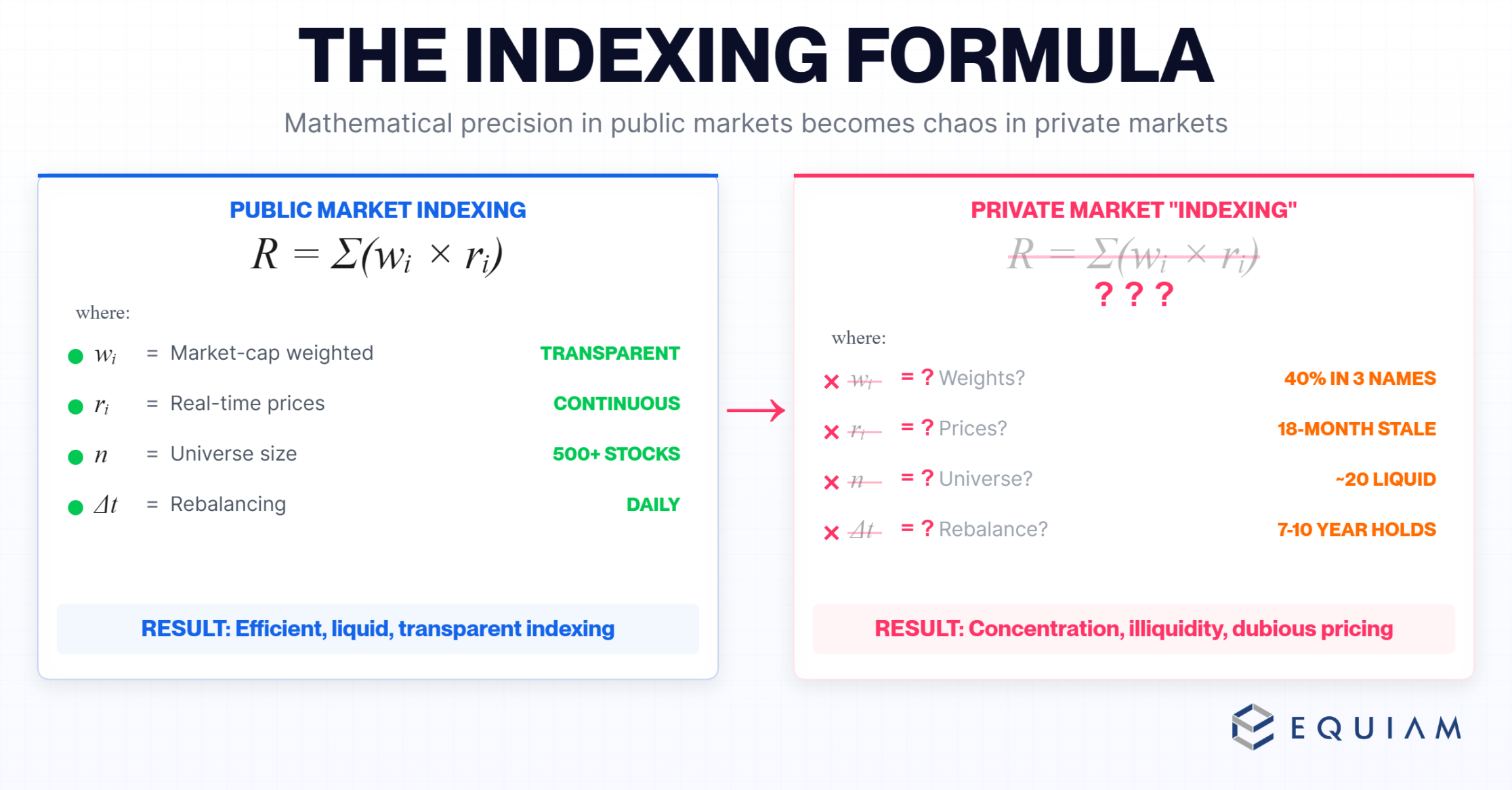
- 01Public-market indexing works because of price discovery, liquidity, and continuous rebalancing. None of those mechanics exist in private markets today.
- 02Private "index" products inevitably crowd into a handful of mega-unicorns and amplify liquidity stress at the worst possible moments.
- 03The path forward is "index-light": diversification with rigorous valuation discipline, portfolio construction, and liquidity alignment.
Few financial innovations have created as much lasting wealth for ordinary investors as indexing. By buying a simple, low-cost index fund, retail investors gain exposure to hundreds or even thousands of companies at once. They no longer have to pick winners and losers or pay high fees to active managers. Over time, indexing has proven again and again to outperform most alternatives, delivering diversification, compounding, and peace of mind. In many ways, it is the single greatest invention for the retail investor.
Where the theory breaks in private markets
Private market managers are racing to replicate indexing's success, promising the same diversification and low fees that revolutionized public investing. But the mechanics that make indexing work simply don't exist (at least today) in private markets.
Price discovery (or lack thereof)
Yes, public markets have bubbles. QQQ crashed 33% in 2022. But here's the critical difference: public market prices, even when wrong, reflect real-time consensus from millions of participants trading billions of shares daily. You can see the correction happening. You can exit if you disagree. The price might be irrational, but at least it's transparently irrational.
Private markets operate in suspended animation. Valuations get set by a single lead investor in a funding round, then frozen for 12-18 months. There's no daily reckoning, no continuous price discovery. Companies carry themselves at their last round price even as comparable public companies crash 70%. When reality finally forces a new funding round, the correction happens all at once: Klarna went from $45.6 billion to $6.7 billion overnight in 2022, an 85% haircut between marks. For eighteen months, investors held an asset worth $7 billion that their statements showed as $45 billion.
Secondary markets have improved price discovery dramatically, creating real-time signals between funding rounds where none existed before. But they remain a far cry from public market liquidity. Daily volume might hit a few million dollars on active days, versus Apple trading $10 billion every session. These markets provide crucial price points, but they're episodic rather than continuous: surging during IPO speculation or other noteworthy news, then quieting for months.
The gap isn't a failure of secondary markets; it's a feature of private ownership. Public markets process trillions of price signals daily across millions of participants. Private markets, even with robust secondaries, operate among only a few thousand qualified buyers and sellers bound by transfer restrictions, information asymmetries, and regulatory constraints. Secondary markets have made private investing more dynamic and transparent than ever before. But for index-style strategies that depend on continuous price discovery and instant liquidity, even the best secondary markets can't replicate what public markets provide effortlessly.
Excessive concentration & herding
A private "index" inevitably crowds into the same few mega-unicorns. Unlike public markets with thousands of tradeable names, the investable private universe with consistent secondary liquidity numbers in the hundreds, not thousands. Even with growing secondary markets, the most liquid names dominate volume: the top 20 companies often represent 60-70% of all secondary trading activity. This concentration creates competitive dynamics that push valuations beyond fundamentals.
When allocators all need exposure to the same blue-chip private names, scarcity premium overtakes valuation discipline. A supposed "index" portfolio often ends up with 30-40% in just a handful of positions.
Tiger Global learned this lesson painfully. Their "spray and pray" approach from 2019-2021 looked like indexing: dozens of late-stage positions across the board. But when the music stopped in 2022, they discovered they'd simply overpaid for concentration risk, marking down the portfolio by 50% and erasing tens of billions in value. Investors indexed to "top unicorns" rode every swing with no ability to exit or rebalance.
The cruel irony: indexing is supposed to protect against single-stock risk through diversification. In private markets, it guarantees concentration in whatever handful of names are hot enough to attract capital. When those names correct, the entire "index" corrects with them.
Liquidity & rebalancing failure
Public indexes seamlessly rebalance, trimming winners and adding new entrants. In privates, investors are locked into vintage exposures for 7 - 10 years. When markets turn, portfolios become skewed, and investors can't adjust. Worse, many are forced into distressed sales.
The "denominator effect" compounds the problem. When public portfolios crash, private allocations suddenly look oversized on paper, forcing institutional investors to sell private holdings at steep secondary discounts just to maintain allocation targets. Index-style exposure doesn't provide the rebalancing resilience it promises; it amplifies liquidity stress at the worst possible moments.
Structural complexity & fee erosion
Direct secondary transactions between sophisticated parties can be clean and efficient. But index-style strategies that must own specific names at any cost often get pushed into the worst corners of the secondary market, where structural complexity becomes predatory.
When an indexer needs SpaceX exposure to meet allocation requirements, they lose negotiating power. They might end up in multi-layered special purpose vehicles (SPVs), where each layer charges its own fees and carry. An investor believes they're buying SpaceX at $185 per share, but they're actually buying into an SPV that charges 2/20, which itself is investing in another SPV charging 2/20, which finally holds the actual shares. By the time all fees compound, that $185 share might need to appreciate to $300 just to break even.
The contrast with selective secondary investing is significant. Disciplined buyers can walk away from bad structures, negotiate better terms, or wait for direct opportunities. But index replication removes that optionality. When you must own 50 - 100 specific companies, you'll take whatever structure is available. Public index funds disclose their fees in a single number. Private "index" products often can't even calculate their true cost until years later, after all the waterfall provisions, hurdle rates, and clawbacks have settled. The promise of simple, systematic exposure becomes a maze of complex financial engineering that favors everyone except the end investor.
The need for an "index-light" approach
So what's the solution? The best path forward is likely an "index-light" model: one that preserves the benefits of indexing while correcting for the flaws of privates. This means layering in rigorous diligence, fair valuation discipline, and thoughtful portfolio construction. Instead of blindly following an index, investors must selectively build diversified exposure while staying disciplined on price and timing.
Enter EQUIAM's Private Tech 30 Fund II
This is precisely where EQUIAM has staked its ground. After eight years of investing in private markets, we have learned firsthand where indexing theory collides with private market reality.
Our solution, the Private Tech 30 Fund II, takes the best of indexing and adapts it for privates:
- Diversification Across 30 Late-Stage Leaders: Exposure to thirty of the largest, fastest-growing private companies, each vetted for scale, growth, and Tier I backing.
- Rigorous Valuation & Underwriting: Entry points are carefully screened with firm go/no-go thresholds, preventing overpayment.
- Portfolio Construction Discipline: Positions are risk-adjusted, not blindly weighted, ensuring balance across the portfolio.
- Liquidity Alignment: By targeting companies approaching IPO or liquidity events in 12 to 36 months, the fund reduces the decade-long lockups that plague traditional private strategies.
Final thoughts
Public market indexing works because transparency, liquidity, and efficiency make it possible. In private markets, those conditions don't exist. But by combining the spirit of indexing with the discipline of private market investing, EQUIAM's approach offers the best of both worlds: diversification without blind price-taking, exposure without overconcentration, and liquidity without decade-long lockups.
John Zic is a Founding Partner at EQUIAM, a San Francisco-based investment firm founded in 2018. For those interested in learning more about EQUIAM's approach to private market investing, please visit equiam.com or shoot a note to our team at info@equiam.com
Disclaimer
This article is for informational purposes only and does not constitute an offer to sell or solicitation of an offer to buy any securities. The EQUIAM Private Tech 30 Fund II referenced herein is available exclusively to qualified purchasers as defined in Section 2(a)(51) of the Investment Company Act of 1940 and is offered pursuant to Rule 506(c) of Regulation D. Private investments are speculative, illiquid, involve substantial risk including complete loss of capital, and are not suitable for all investors. Past performance does not guarantee future results, and all projections are hypothetical with wide bands of potential outcomes. The information presented has not been independently verified, and readers should consult their own legal, tax, and financial advisors before making any investment decision. EQUIAM LLC makes no representations or warranties regarding the accuracy or completeness of information from third-party sources cited herein.
Connect with Our Team
Interested in learning more about our investment approach?