Wrapocalypse Now: Part 2 of 3
NVIDIA does not fabricate its own chips. It outsources the most capital-intensive layer in its stack to TSMC, and still captures most of the economic surplus. Part two of a three-part series on what makes some wrappers durable, and what compounds above the substrate.
- 01NVIDIA outsources the most capital-intensive layer in its stack to TSMC and still captures most of the economic surplus, because what compounds (e.g., GPU architecture, CUDA, developer mindshare, customer relationships) sits above the substrate.
- 02Substrates reach up selectively, not universally. Becoming the wrapper would force the substrate to abandon the horizontal economics that made it powerful in the first place: TSMC's neutrality, OpenAI's platform motion.
- 03The NVIDIA-vs-Dell split is the entire AI application-layer debate in miniature. Same wrapper position, very different outcomes.
Part II: NVIDIA, TSMC, and the Anatomy of a Durable Wrapper
In Part I, we argued that "wrapper" is not an insult. It's a description of a company's position in a value chain.
Many of the world's most valuable companies sit above substrates they do not own. Salesforce sits above cloud infrastructure and database layers. Snowflake sits above AWS, Azure, and GCP. Stripe sits above card networks, banks, acquiring infrastructure, and compliance rails. Nike sits above contract manufacturing.
This does not mean every wrapper is durable. It means the word itself does not tell you much.
The cleanest case study is NVIDIA.
It does not fabricate its own chips. It outsources the most capital-intensive layer in its entire stack. The physical production of the silicon on which its empire depends happens somewhere else, primarily at TSMC. And yet NVIDIA captures extraordinary economic surplus.
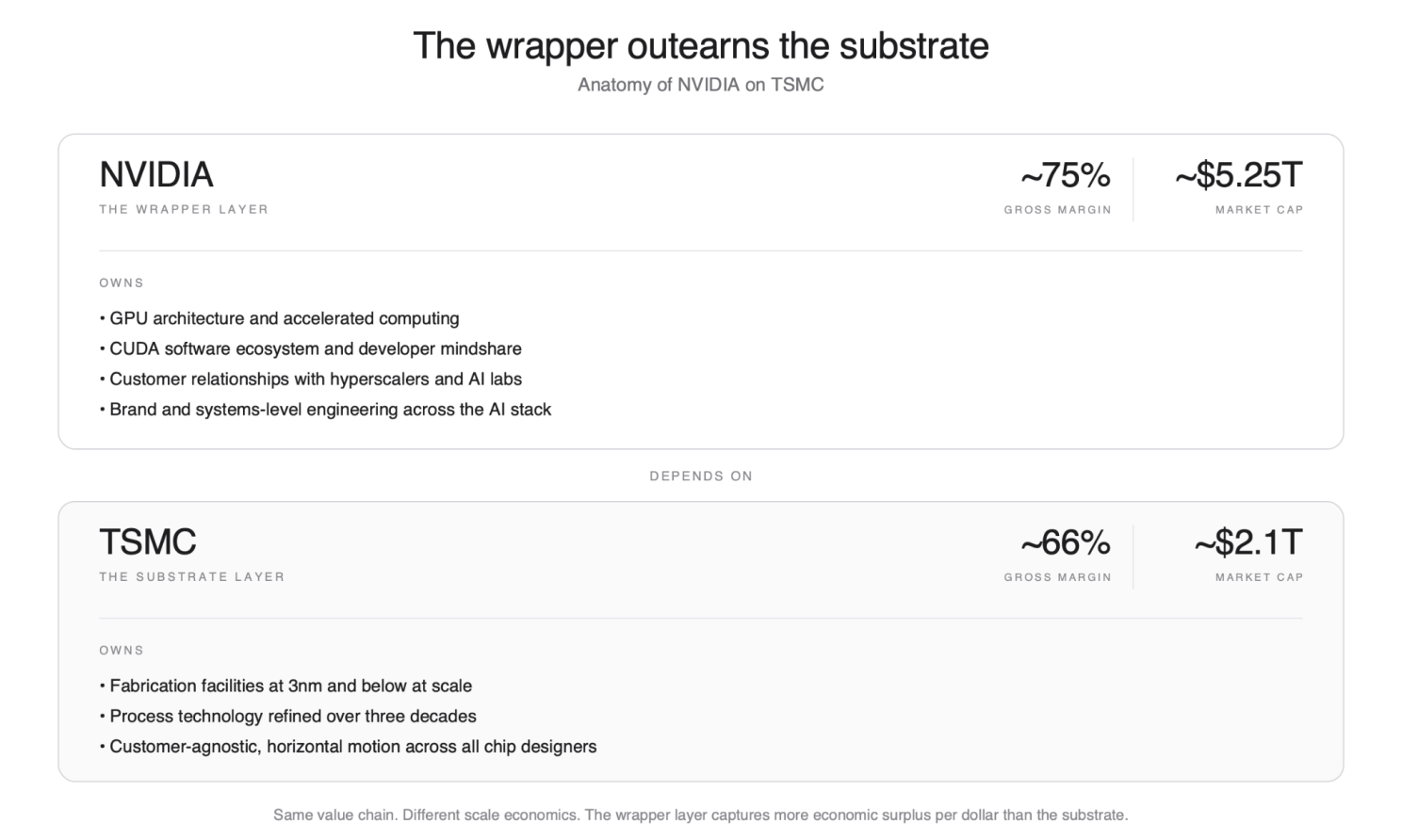
NVIDIA designs GPU architecture, develops the CUDA software ecosystem, owns the developer relationship, and sells into hyperscalers and AI labs. Its business is capital-light, use-case-specific, and vertically entangled with the workloads its chips run.
TSMC owns the fabs, the process technology, and the manufacturing throughput required to produce advanced chips at scale. Its business is capital-intensive, manufacturing-driven, customer-agnostic, and horizontal.
However, they are not playing the same game.
The same dynamic is now playing out in AI: foundation models below, application companies above, and a live argument about which layer captures the value.
Why does TSMC not become NVIDIA?
The answer is that doing so would damage the very economics that make TSMC powerful.
TSMC's foundry model depends on neutrality. It serves Apple, NVIDIA, AMD, Qualcomm, Broadcom, MediaTek, and many others. Its customers trust it because it is not trying to compete with them in their end markets.
If TSMC decided to build its own NVIDIA competitor, it would create an immediate conflict with some of its most important customers. It would force customers to ask whether their manufacturing partner was also becoming their competitor. It would undermine the neutrality that makes the foundry model work.
It would also require TSMC to build capabilities far outside its core competence.
Chip design is not just "decide to make a chip." NVIDIA's advantage is not merely that it has GPU schematics. It has architecture expertise, compiler work, libraries, developer adoption, CUDA, systems integration, workload-specific optimization, a brand with engineers, and a sales motion into the customers building the most valuable AI infrastructure in the world.
A substrate can reach up, but reaching up is not free. It often requires abandoning or weakening the horizontal economics that made the substrate valuable in the first place.
Now map this onto AI.
OpenAI and Anthropic can build vertical applications, but becoming Harvey, Glean, Sierra, or Hippocratic AI means taking on a different kind of company: vertical sales, deep integrations, domain-specific liability, and compliance. A horizontal substrate has to ask whether a given vertical is large enough, strategically important enough, and operationally compatible enough to justify fragmenting its platform motion. Very often the answer is no.
And the reverse, why doesn't NVIDIA build its own fabs?
Because doing so would force NVIDIA to spend enormous capital and management attention on a layer where TSMC has a multi-decade advantage.
Once again, the analogy to AI applications is direct.
An AI application company can decide to train its own frontier model, but for most, it will be a mistake. Training frontier models consumes capital, talent, infrastructure, and executive attention. Worse, it drags the company into competition with the best-capitalized firms on earth.
For an application company, the more important question is: "What can we own above the model that becomes more valuable as models improve?"
The answer might be workflows, proprietary data, or simply the customers' operating history sitting inside the product.
That is what NVIDIA did. It let TSMC be TSMC. And it built CUDA.
CUDA is what compounds
The mistake in the wrapper critique is that it looks down the stack and sees dependence, but it does not look up the stack and ask what is compounding.
For NVIDIA, the answer is CUDA.
CUDA turned NVIDIA from a chip designer into an ecosystem company. It gave developers a way to program GPUs. It made NVIDIA hardware more useful because the software layer around it was more mature. It made the software layer more valuable because the hardware base was larger. It created a feedback loop between developers, libraries, workloads, customers, and chips.
The equivalent AI application-layer question should always be: what is this company's CUDA?
Not literally a developer platform. But what is the compounding asset above the model?
For Glean, the connector graph and permission graph. For Harvey, legal workflow depth and trust with AmLaw buyers. For Sierra, customer-service playbooks and escalation data.
For many companies, the honest answer is: nothing yet.
Those are the companies the wrapper critique is correctly worried about.
Dell, and the fragile vs durable split
Dell also wrapped powerful substrates.
It wrapped Intel for CPUs, Microsoft for the operating system, and a global components supply chain for everything else. It built a highly efficient business around assembling and distributing personal computers.
For a time, that was valuable. Dell's direct-sales model, supply-chain efficiency, and working-capital discipline were real advantages.
The issue was that Dell did not accumulate the kind of proprietary layer above the substrate that NVIDIA did. Their edge boiled down to mostly assembly margin, distribution efficiency, and brand.
As the PC market matured, the economics compressed. Intel and Microsoft captured enormous value from above. Asian manufacturers and assemblers pressured from below. The PC became more modular, more standardized, and more price-competitive. Dell's wrapper position did not disappear. It just became less economically powerful.
The NVIDIA vs. Dell split is the entire AI application-layer debate in miniature.
A fragile AI wrapper is easy to describe: a thin UI on a single model with no proprietary data, no workflow ownership, no material switching cost. Its failure modes are predictable. If the model provider ships the feature natively, the company is gone. If a competitor copies the workflow and undercuts on price, the company is gone. If distribution gets more expensive, there's no second act.
A durable AI wrapper looks different, even when it sits on the same substrates. It may still run on OpenAI, Anthropic, Gemini, or some combination underneath, but it accumulates something above them that gets harder to replicate over time. Sometimes that's a workflow that matters, a proprietary data asset, or trust earned in a high-stakes domain.
The result is a company that benefits from model improvement without being defined by any single model. That's not "just a wrapper" in any useful analytical sense; it's an application-layer company. The final question is whether it's compounding fast enough.
The real substrate threat is selective, not universal
The wrapper critique often assumes the substrate provider will absorb everything above it.
That is not how substrates usually behave.
Substrates reach up selectively. They reach up when the use case is broad, the application layer is thin, and the workflow doesn't force them to become a different kind of company.
But they do not reach up everywhere.
- AWS did not absorb every company built on AWS.
- Visa did not absorb Stripe.
- TSMC did not absorb NVIDIA.
- Foxconn did not absorb Apple.
- The New York Stock Exchange did not absorb Bloomberg.
- Contract manufacturers did not absorb Nike.
The substrate can be powerful without owning all the surplus above it.
In AI, foundation model providers will absolutely absorb some applications. They will bundle features. They will launch native surfaces. They will move into broad horizontal workflows. They will compress pricing.
They will not, however, own every vertical workflow, every compliance-heavy buyer relationship, every customer-specific operating layer.
That gap is where durable companies get built.
Up next
If "wrapper" is too blunt, investors and operators need a better map. Part III will dig into six dimensions for evaluating AI application-layer companies:
- Workflow position
- Substrate relationship
- Proprietary asset accumulation
- Buyer trust and distribution
- Switching cost
- Margin trajectory
The goal is to stop asking whether something is a wrapper and start asking where, exactly, it stands. Continue to Part III →
Disclaimer
This article is for informational purposes only and does not constitute an offer to sell or solicitation of an offer to buy any securities. Companies referenced herein are for illustrative purposes only and do not represent investment recommendations or current EQUIAM portfolio holdings unless explicitly noted. Private investments are speculative, illiquid, involve substantial risk including complete loss of capital, and are not suitable for all investors. Past performance does not guarantee future results, and all projections are hypothetical with wide bands of potential outcomes. The information presented has not been independently verified, and readers should consult their own legal, tax, and financial advisors before making any investment decision. EQUIAM LLC makes no representations or warranties regarding the accuracy or completeness of information from third-party sources cited herein.
Connect with Our Team
Interested in learning more about our investment approach?