
Wrapocalypse Now: Part 3 of 3
If "wrapper" is too blunt to be useful, what should replace it? A map. Part three completes the series with the six dimensions that actually matter for evaluating AI application-layer companies, the five archetypes that emerge once you map them, and why archetypes are not destinies.
- 01"Just a wrapper" is a category error. Companies above the foundation-model layer sit in a multi-dimensional space, same substrate, radically different businesses.
- 02Six dimensions actually matter: workflow position, substrate relationship, proprietary asset accumulation, buyer trust + distribution, switching cost, and margin trajectory. The framework is the lens, the weights are yours.
- 03Five archetypes emerge: Workflow Specialist, Surface Player, Distribution Aggregator, Vertical Integrator, and Substrate-Adjacent Tool. The current archetype tells you what the company is today; the direction of travel tells you what it might become.
Part III: The Six Dimensions That Actually Matter for AI Apps
In Part I, we argued that "wrapper" describes a company's position in a value chain rather than an insult.
Part II used NVIDIA and Dell to show why that position can produce radically different outcomes. One became the defining company of the AI infrastructure era. The other became a lower-margin hardware integrator.
That brings us to the practical question.
If "wrapper" is too blunt to be useful, what should replace it?
The answer is a map.
There is no single line from 'bad wrapper' to 'good company.' These companies sit in a multi-dimensional space. Two companies can both sit on the same foundation model and still be structurally different in almost every way that matters.
They can sell to different buyers. Sit in different workflows. Accumulate different assets. Face different competitors. Retain different amounts of substrate cost deflation. Generate different switching costs. Deserve different multiples.
The wrapper label compresses all of that into one bit. The analysis lives in the dimensions.
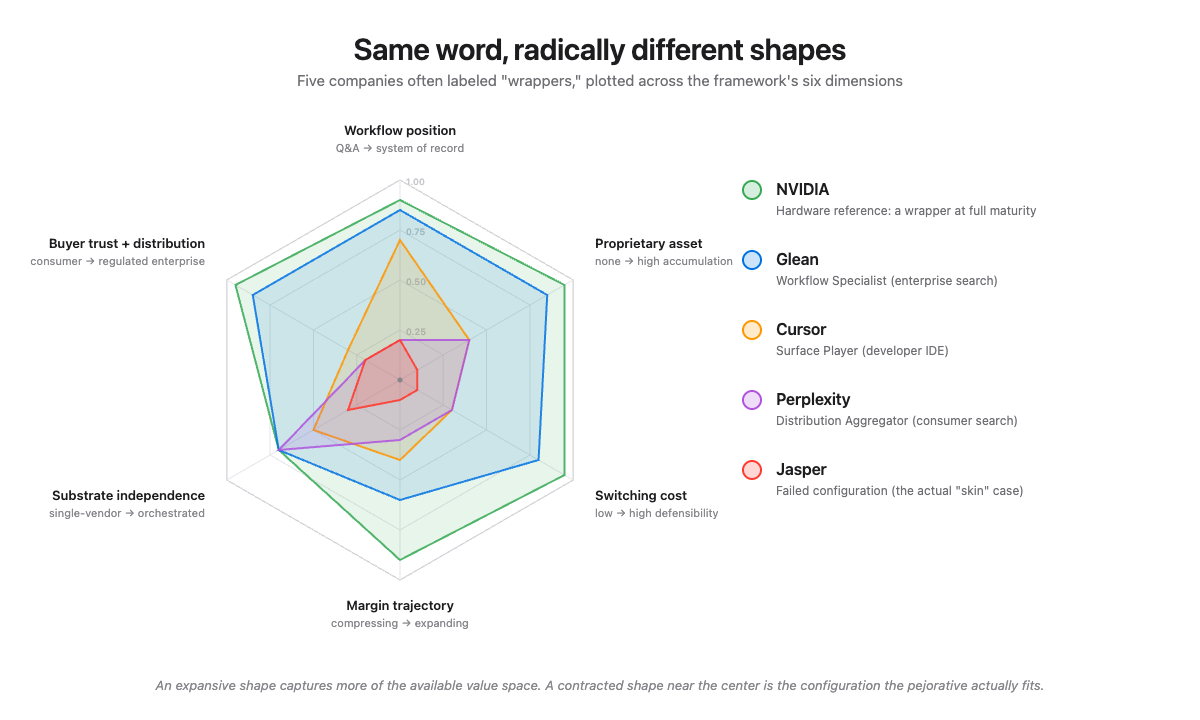
A note on terminology: throughout this piece when discussing AI-applications, 'substrate' refers to the foundation model layer beneath the application.
The core distinction: workflow-deep or surface-convenient
Before getting to the six dimensions, there is one framing distinction that runs through all of them.
The single most predictive question about an AI application company is whether the value it produces is workflow-deep or surface-convenient.
Workflow-deep value is hard to replace because it is woven into the customer's operations, and those operations have woven themselves around it in return.
Surface-convenient value is easier to replace because the user is one habit-break away from leaving.
A product can be useful, beloved, and frequently used while still being surface-convenient.
Cursor sits in an IDE all day. But if its primary switching cost is habit, it is still exposed to native attacks from Claude Code, Codex, or other substrate-bundled coding products.
Glean also sits in enterprise workflows, but its switching costs are different. It integrates across systems, maps permissions, indexes company knowledge, clears procurement, and embeds into enterprise information architecture. The product accumulates organizational context.
Note: The six dimensions discussed below are deliberately unweighted. The framing is novel enough that imposing explicit weights would be premature. Each reader should weight the dimensions according to their own thesis, time horizon, and accumulated pattern recognition. A growth-stage investor on a two-year horizon will weigh switching cost and margin trajectory differently than a Series A investor underwriting a seven-year venture outcome. The framework is the lens, the weights are yours.
Dimension 1: Workflow position
Workflow position determines almost everything else: sales motion, retention, expansion, margin, implementation burden, competitive set, and the likelihood of substrate absorption.
At the shallow end, the product answers open-ended questions or helps with single-turn drafting.
At the deeper end, it orchestrates multi-step work, coordinates across systems, makes decisions inside a business process, and writes back into the system of record.
A product that helps an employee draft a paragraph competes with other writing surfaces, browser tabs, and the next capability upgrade from the substrate.
A product that runs a customer-support workflow, updates the CRM, escalates edge cases, observes policy constraints, learns from prior resolutions, and becomes part of the operating cadence competes in a different market.
The deeper the workflow position, the harder it is for the substrate to absorb the product with a feature launch.
Workflow position is not enough by itself. A product can sit in an important workflow and still fail to build defensibility. However, without workflow depth, almost every other dimension has to work harder.
The key question is:
If this product disappeared tomorrow, would the customer be annoyed, or would an operating process break?
Dimension 2: Substrate relationship
At one extreme, a company can be single-vendor, single-model, and tightly coupled to one provider's roadmap.
At the other, a company orchestrates across multiple frontier and open-source models, routing by task, price, latency, reliability, policy, and customer preference.
Neither architecture is automatically superior. They are different bets.
Single-vendor architectures are simpler. They ship faster. They can exploit the provider's newest capabilities early. They are easier to maintain. They are often the right starting point.
The problem is that they inherit the provider's roadmap, pricing, outages, policy decisions, and product direction. They are more exposed if the provider launches a native feature that collapses the application's value.
Multi-model architectures are more complex. They carry an engineering tax. They require abstraction layers, evaluation infrastructure, monitoring, fallbacks, and routing logic. They can also create two forms of value that single-vendor products cannot easily match.
The first is economic: arbitrage.
As model costs fall and capabilities converge, a model-agnostic application can route each task to the best price-performance option. It can benefit from competition among substrates rather than being hostage to one of them.
The second is diagnostic: triangulation.
A product that routes the same query through multiple independent models and surfaces disagreement catches what no single model can on its own: blind spots correlated with that model's training.
In low-stakes workflows, that may not matter.
In research, legal analysis, clinical decision support, and financial diligence where errors compound, it matters a lot.
The key question is:
Does the company get stronger as model providers compete, or is it trapped inside one provider's choices?
Dimension 3: Proprietary asset accumulation
A company can launch with a thin product and become durable if every customer interaction creates an asset that compounds. A company can launch with a beautiful product and remain fragile if usage leaves nothing behind.
The assets can take many forms:
- Customer-specific agent libraries
- Curated and labeled domain datasets
- Permission graphs
- Compliance artifacts
- Brand trust in a high-stakes domain
- Operating data across customers
The critical distinction is whether those assets are substrate-dependent or substrate-independent.
Substrate-dependent assets decay when the substrate advances.
A prompt library written for GPT-4 may become technical debt when GPT-6 ships. A fine-tune built on one model may be less useful when the base model changes. A RAG configuration optimized for one context window may need to be rebuilt when context windows expand. These assets are real, but they are sandcastles.
Substrate-independent assets compound regardless of what the substrate does.
A curated legal corpus remains valuable whether GPT, Claude, Gemini, or Llama reads it. A permission graph certified into an enterprise environment does not lose value when models improve. A healthcare workflow that cleared compliance, earned clinical trust, and embedded into care operations does not become obsolete just because the model gets smarter.
In fact, substrate-independent assets often become more valuable as models improve because better models can extract more value from them.
This is the Glean vs. Jasper distinction.
Glean's connector graph, permission graph, enterprise integrations, and organizational context are durable assets. They get more useful as the model layer improves.
Jasper's early GPT-3 prompt advantage was much more substrate-dependent. When the substrate improved and a horizontal product appeared, much of the differentiation collapsed.
The key question is:
Does the asset compound as the substrate improves, or does it decay when the substrate advances?
Dimension 4: Buyer trust and distribution profile
This dimension is often underrated because people talk about product and model capability as if buyers are interchangeable.
They are not. Here are four concrete examples:
- A consumer-paid product is a marketing, retention, and habit business. It competes for attention and default behavior.
- An SMB self-serve product is a top-of-funnel and activation business. It needs fast onboarding, clear value, and efficient acquisition.
- A mid-market sales-led product is a quota, CAC, and expansion business. It needs repeatable sales motion, ROI proof, and customer success.
- A regulated-enterprise product is a procurement, compliance, indemnity, and integration business. It may need SOC 2, HIPAA BAAs, security questionnaires, role-based permissions, audit logs, and a long sales cycle.
The same product with the same model underneath can become a completely different business if the buyer changes.
This also changes the competitive map.
Procurement complexity is a moat against some competitors and useless against others.
Against substrate providers going direct, procurement complexity can be a moat. Horizontal model companies do not always want to run vertical sales, compliance, implementation, and support motions in every specialized market.
Against indie "GPT for X" startups, procurement complexity is also a moat. Many cannot afford to clear enterprise procurement before they run out of runway.
However, against adjacent incumbents, procurement complexity may not be a moat at all.
If Microsoft, Salesforce, Adobe, Thomson Reuters, Epic, Bloomberg, ServiceNow, Intuit, or another incumbent already owns the procurement relationship, identity layer, compliance posture, data access, and budget line, then the startup is not protected by procurement complexity. It is threatened by someone who has already paid that cost.
That is why the most dangerous competitor is often not the foundation model provider.
It is the incumbent that wraps the foundation model and ships through existing distribution.
The key question is:
Who already has the buyer's trust, budget, identity layer, procurement clearance, and data access?
Dimension 5: Switching cost and defensibility
Founders overstate switching costs constantly. They confuse usage with lock-in, enthusiasm with dependency, and habit with moat.
Switching costs come in different types, and they compound at different rates.
- Habit. The user is used to the product. Switching means breaking a rhythm. Cost: minutes to a week.
- Brand and trust. The user trusts the product. Switching means building trust in a new vendor. Cost: weeks.
- Workflow. The team has built processes around the product. Switching means retraining people and rebuilding workflows. Cost: months.
- Data and integration. The product is connected to internal systems and has accumulated data, configurations, permissions, and customer-specific context. Switching means rebuilding integrations and migrating or recreating data. Cost: quarters to years.
- Procurement. Replacing the product means redoing vendor approval, legal review, compliance review, security review, and budget approval. Cost: a fiscal year or more in regulated enterprises.
Cursor and Perplexity may have real user love and real habit. That is valuable. But habit is the weakest switching cost.
Glean has data, integrations, permissions, and procurement. That is a different kind of defensibility.
A vertical healthcare or legal product that has cleared compliance, trained teams, integrated into workflows, and become part of the firm's operating procedures has a different switching profile again.
The key question is:
If a comparable product launched tomorrow at half the price, how long would it take to switch, how much would it cost, and what specifically would you have to rebuild?
Dimension 6: Margin trajectory against substrate cost deflation
Foundation model costs are falling quickly. Capabilities are improving. Latency is improving. Open-source models are getting stronger. Competition among model providers is intensifying.
In theory, this should be good for application-layer companies. If the substrate gets cheaper and better, the application should be able to deliver more value at lower cost.
That said, there is a condition.
The application company only benefits if it can retain some of the surplus.
If the market is fragmented, switching costs are low, and products are easy to copy, substrate cost deflation gets passed through to customers in the form of lower prices.
If the market is concentrated, switching costs are high, and proprietary assets are accumulating, the company can retain more of the benefit as gross margin expansion.
That makes margin trajectory one of the cleanest financial signals in the category.
A company whose gross margin is flat while model costs fall is probably not moving up-stack fast enough. It may be growing revenue, but it is not necessarily capturing more of the value chain.
A company whose gross margin expands as model costs fall may be doing something more interesting. It may be turning substrate improvement into application-layer surplus.
The goal is to separate top-line growth from structural improvement.
Many AI application companies will grow quickly because the category is growing quickly. That does not mean they are becoming more defensible.
The key question is:
As the substrate gets cheaper and better, does this company keep more of the value, or does the market force it to give the savings away?
Five archetypes
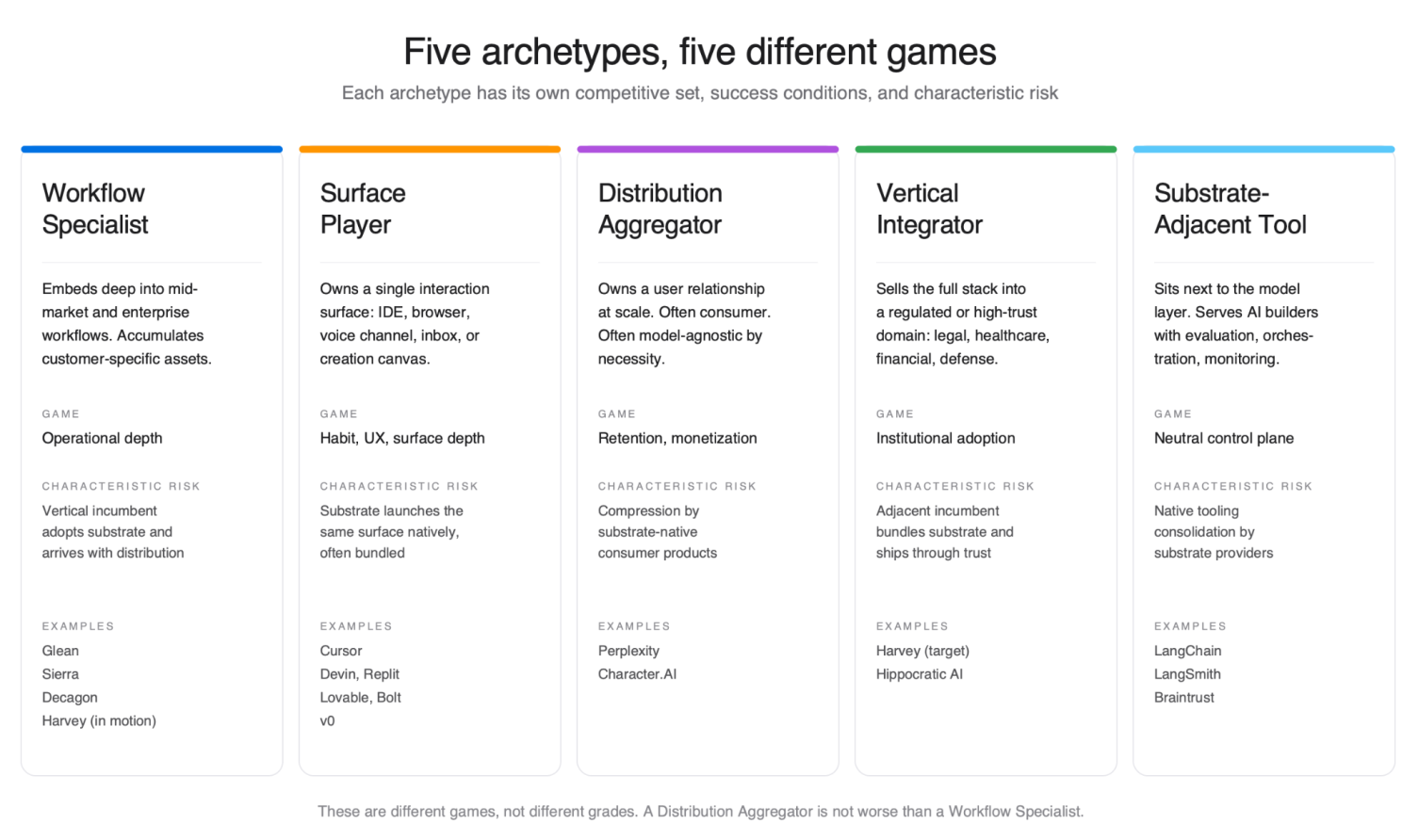
Once you map companies across these six dimensions, patterns emerge.
Most AI application-layer companies fall into one of five archetypes.
The Workflow Specialist
The Workflow Specialist lives high on the workflow ladder. It sells into mid-market or enterprise. It accumulates customer-specific assets such as playbooks, integrations, tuned workflows, domain context, and operating histories.
How much of the customer's day-to-day work can it own? How deeply can it embed into operations? How hard would it be to remove without breaking a process?
Its characteristic risk is the incumbent in its vertical adopting the substrate and arriving with decades of distribution. The substrate provider going direct is the lesser threat.
Examples include Glean, Sierra, Decagon, and parts of Harvey, depending on the revenue mix.
The Surface Player
The Surface Player owns an interaction surface: an IDE, browser, meeting room, voice channel, inbox, or creation canvas.
The product may be used constantly. It may feel magical. It may grow very quickly. But the value lives mostly in the surface, with limited proprietary data, integrations, or workflow ownership behind it.
Its game is habit, UX, speed, and surface depth.
Its characteristic risk is the substrate provider launching the same surface natively, often bundled with distribution or compute advantages.
The defense is migration.
A Surface Player must move down-stack into proprietary assets, team workflows, data, integrations, or systems of record before the substrate-native attack arrives.
Cursor, Devin, Replit, Lovable, Bolt, and v0 all live somewhere in this zone, though they are trying to move in different directions.
The Distribution Aggregator
The Distribution Aggregator owns a user relationship at scale, often consumer-facing and often model-agnostic by necessity.
Its workflow value per interaction may be shallow, but its asset is attention, habit, brand, and user data.
Its game is retention and monetization.
Can it become a default behavior? Can it maintain attention as model-native products improve? Can it convert usage into revenue without destroying the experience that created the usage in the first place?
Its characteristic risk is compression from substrate-native consumer products and the difficulty of monetizing behavior that was trained on free or near-free usage.
Perplexity and Character.AI are examples.
The Vertical Integrator
The Vertical Integrator plays in a regulated or high-trust domain: legal, healthcare, financial services, insurance, defense, government, accounting, or other areas where mistakes are expensive and trust is hard to earn.
It sells the full stack into a vertical: workflow, data, integrations, compliance, auditability, indemnity, and trust.
Can it clear procurement? Can it earn trust? Can it integrate into the systems where work actually happens? Can it handle liability? Can it become part of the buyer's operating model?
The existential risk is bundling by an adjacent incumbent that already owns the buyer relationship. Each bundle pairs an incumbent with a frontier model:
- Legal: Thomson Reuters or LexisNexis
- Healthcare: Epic
- Enterprise productivity: Microsoft + OpenAI
- Sales: Salesforce
The Vertical Integrator's opportunity is the gap between the incumbent waking up and the incumbent shipping something good enough. That gap has narrowed materially. In 2023, it was three to four years. In 2026, it is closer to one to two. Incumbents across major sectors are all shipping AI-bundled products into their installed bases. The Vertical Integrator's defense increasingly depends on speed of customer acquisition and depth of workflow embedding before the bundle arrives.
Harvey and Hippocratic AI are examples of companies pushing toward this archetype.
The Substrate-Adjacent Tool
The Substrate-Adjacent Tool sits next to the model layer rather than purely above it.
It serves developers, AI engineers, ML teams, product teams, and operators building with models. The category includes evaluation, observability, orchestration, monitoring, fine-tuning, guardrails, agent infrastructure, and testing.
The more companies build on models, the more they need tools to evaluate, monitor, secure, and operate those systems.
Its characteristic risk is native tooling consolidation. Model providers and cloud providers will build more of this functionality themselves.
The question is whether the independent tool becomes the neutral control plane across substrates or gets compressed into a feature.
LangChain, LangSmith, Braintrust, and related infrastructure companies sit in this archetype.
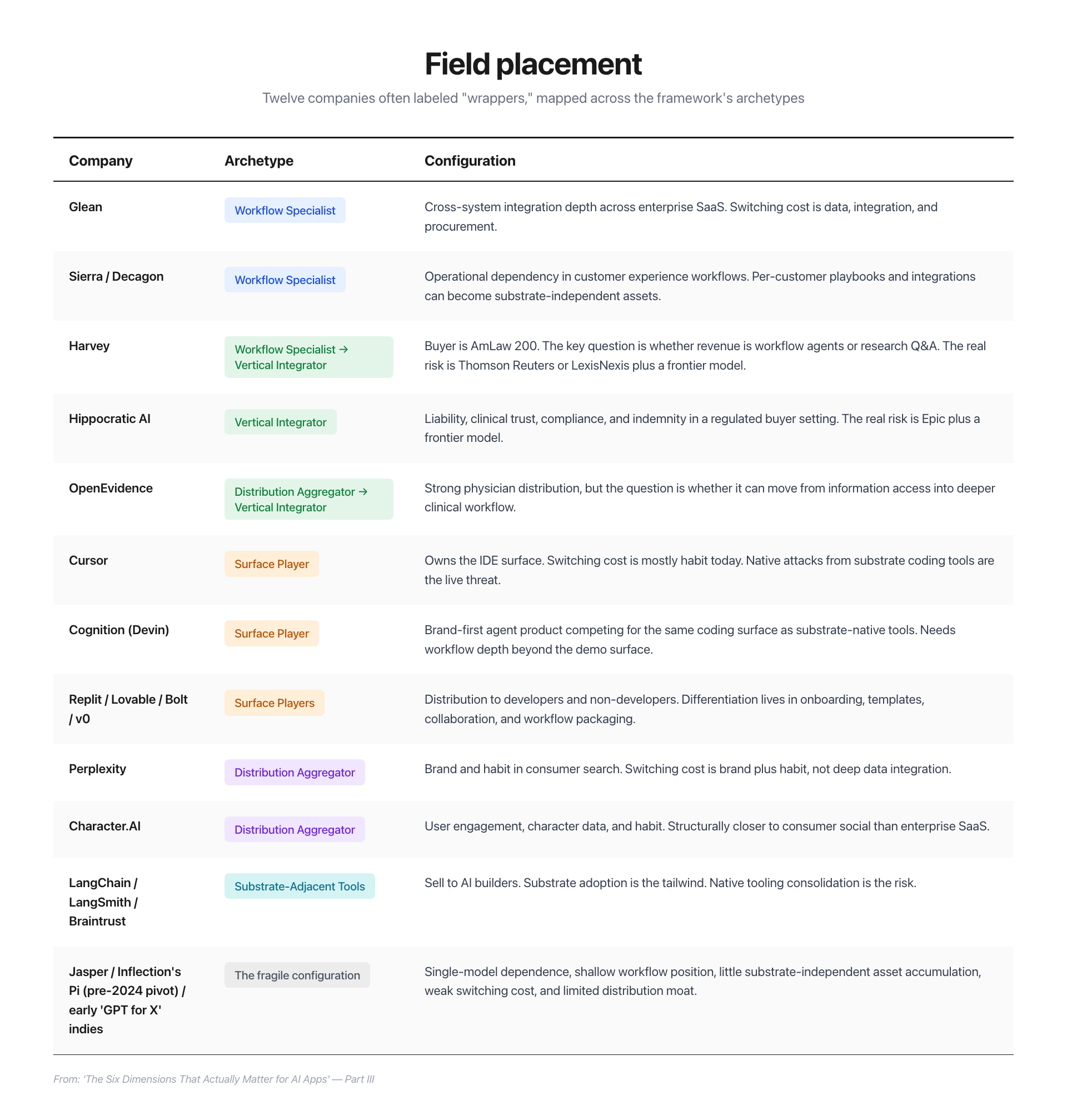
Field placement (May 2026)
The point of the table below is to show how different the configurations are despite all being called "wrappers." This is not meant to be an explicit ranking.
Archetypes are not destinies
Surface Players are trying to become Workflow Specialists.
Distribution Aggregators are trying to become trusted vertical entry points.
Workflow Specialists are trying to become Vertical Integrators.
Substrate-Adjacent Tools are trying to become neutral control planes.
The current archetype tells you what the company is today. The direction of travel tells you what it might become.
A Surface Player can be exposed and still be investable if it is migrating quickly into deeper workflow ownership. A Workflow Specialist can look strong and still be vulnerable if the incumbent is moving faster than expected. A Distribution Aggregator can have massive usage and still struggle if it cannot monetize or deepen the relationship. A Vertical Integrator can look defensible and still lose if the buyer prefers the incumbent's good-enough bundle.
The key question is:
What archetype is this company becoming, and is the motion visible in the product, customer behavior, and financials?
If a company claims it is moving from surface to workflow, you should see expansion, retention, implementation depth, team adoption, integration count, customer-specific configuration, or margin improvement.
If a company claims it is moving from distribution to vertical trust, you should see deeper use cases, higher-stakes workflows, paid conversion, institutional adoption, or procurement wins.
If a company claims it is building proprietary assets, you should see evidence that those assets reduce churn, improve output quality, expand gross margin, or increase switching costs.
"Just a wrapper" is a category error
This framing would have missed Salesforce, Snowflake, Stripe, and Bloomberg, all of which looked, at inception, like they were sitting on someone else's substrate. It will miss the durable AI companies for the same reason. The framing collapses configuration into substrate and treats every company above the model layer as interchangeable.
They are not interchangeable. Some accumulate scarce data, deepen workflows, and earn buyer trust the substrate cannot replicate without going customer-by-customer. Others are one feature launch away from irrelevance. Both get called wrappers, right up until one becomes a category-defining business and the other becomes a postmortem.
Disclosure: EQUIAM funds currently hold a position in Perplexity. The firm has no position in any other company mentioned in this piece as of May 7, 2026. This article reflects the author's personal views and is for informational purposes only. It is not investment advice.
Disclaimer
This article is for informational purposes only and does not constitute an offer to sell or solicitation of an offer to buy any securities. Companies referenced herein are for illustrative purposes only and do not represent investment recommendations or current EQUIAM portfolio holdings unless explicitly noted. Private investments are speculative, illiquid, involve substantial risk including complete loss of capital, and are not suitable for all investors. Past performance does not guarantee future results, and all projections are hypothetical with wide bands of potential outcomes. The information presented has not been independently verified, and readers should consult their own legal, tax, and financial advisors before making any investment decision. EQUIAM LLC makes no representations or warranties regarding the accuracy or completeness of information from third-party sources cited herein.
Connect with Our Team
Interested in learning more about our investment approach?